


INTRODUCTION
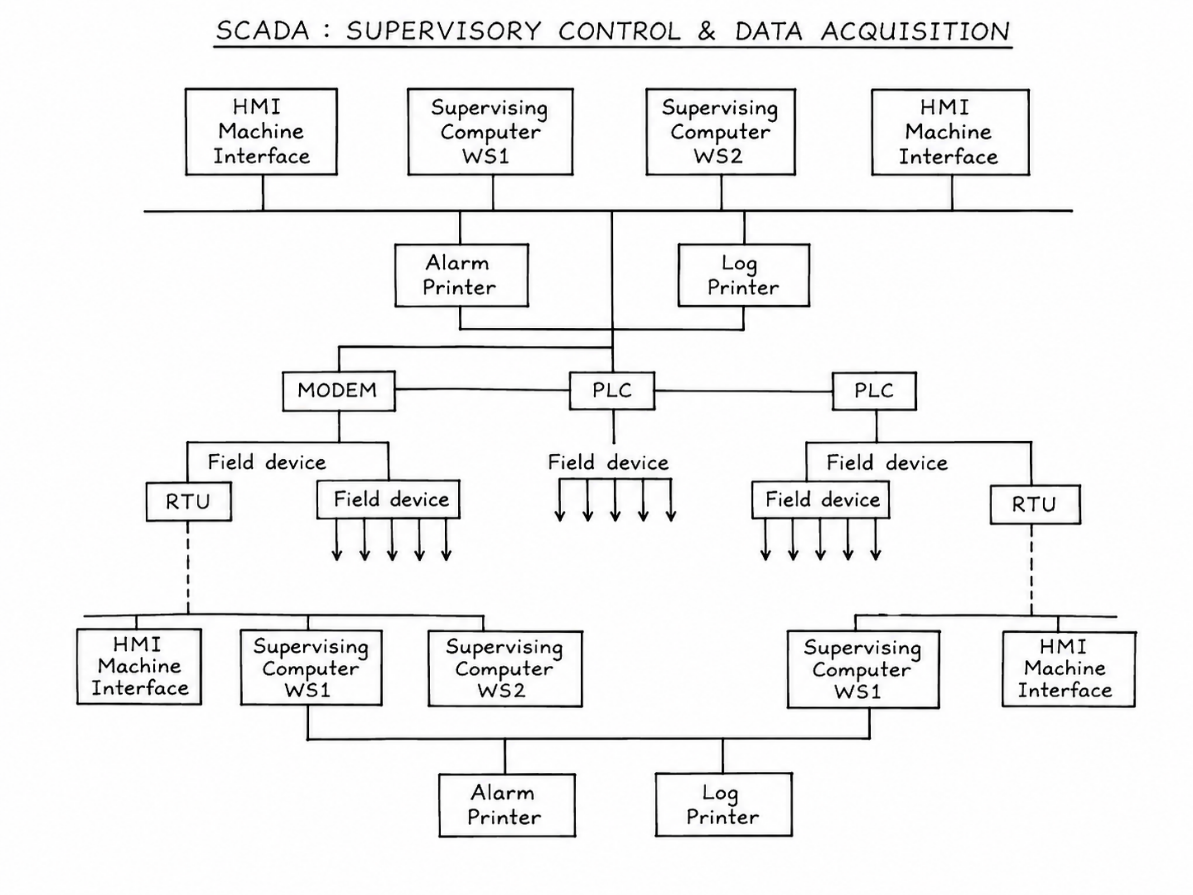
SCADA stands for Supervisory Control and Data Acquisition. It is an advanced automation and industrial monitoring system used to supervise, monitor, and control industrial processes from a central control station. SCADA systems are widely used in industries such as marine engineering, power generation plants, oil and gas industries, water treatment plants, manufacturing industries, and electrical distribution systems. The main objective of SCADA is to collect real-time information from field devices, process the data, display it to operators, and provide efficient control over machinery and industrial operations.
Main Components of SCADA System
1 Human Machine Interface (HMI)
The Human Machine Interface is the communication interface between the operator and the SCADA system. It displays graphical information such as pressure, temperature, tank levels, alarms, machinery conditions, and operational status. Through HMI, operators can monitor and control industrial equipment from a central location.
2. Supervisory Computers
Supervisory computers collect and process data received from PLCs and RTUs. These computers analyze the system condition, generate alarms, store historical records, and provide operational control to the operators. They act as the main control center of the SCADA system.
3. Programmable Logic Controller (PLC)
PLC is an industrial digital controller used for automatic process control. It receives signals from field devices, processes the information according to programmed instructions, and controls machinery operations such as motors, pumps, valves, and switches.
4. Remote Terminal Unit (RTU)
RTUs are remote data collection devices installed at distant locations. They collect information from sensors and field instruments and transmit the data to the central supervisory system. RTUs are especially useful in remote industrial and marine applications.
5. Field Devices
Field devices include sensors, transmitters, actuators, switches, motors, valves, pressure gauges, temperature sensors, and flow meters. These devices continuously provide real-time process information to PLCs and RTUs.
6. Communication System
The communication system transfers information between field devices, PLCs, RTUs, and supervisory computers. Communication may take place through Ethernet cables, fiber optics, radio communication, wireless networks, or modem systems.
Functions of SCADA System
1. Data Acquisition
The SCADA system continuously collects real-time operational data such as temperature, pressure, level, speed, voltage, current, and flow rate from field devices and sensors.
2. Monitoring of Industrial Processes
SCADA systems provide continuous monitoring of machinery and industrial operations. Operators can observe all process parameters through graphical displays and control panels.
3. Remote Control Operation
SCADA enables operators to remotely start, stop, regulate, and control industrial equipment directly from the control room without physically visiting the machinery location.
4. Alarm Handling System
Whenever abnormal conditions occur, such as overheating, overload, low pressure, high vibration, or machinery failure, the SCADA system automatically generates alarms and warning signals for immediate corrective action.
5.Data Logging and Historical Records
SCADA systems store operational data and event records for future analysis, troubleshooting, maintenance planning, and performance evaluation.
Application of SCADA in Marine Engineering
SCADA systems are extensively used onboard ships for monitoring and controlling:
- Main engine parameters
- Auxiliary engine systems
- Boiler automation
- Cargo handling systems
- Ballast control systems
- Power management systems
- Tank level monitoring
- Alarm monitoring systems
- Engine room automation systems