


Working Description
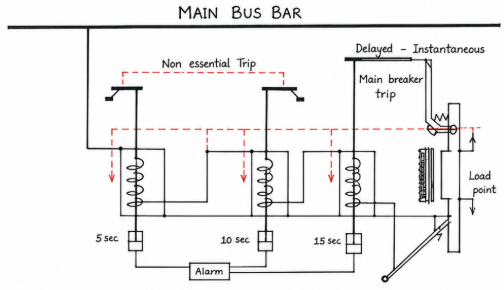
The preferential trip unit consists of an electromagnetic coil and a dashpot arrangement to provide a time delay in disconnecting circuits. This system is mainly used in ship electrical systems to prevent generator overload by automatically shedding non-essential loads.
The dashpot arrangement consists of a small piston with a small orifice, which is placed inside a cylinder filled with silicon fluid. When the piston moves, the fluid resists its motion, and this resistance creates a time delay. The amount of delay depends on the size of the orifice and the movement of the piston.
When current flows through the electromagnetic coil, the linkage is held away from contact by a spring arrangement. As soon as the current exceeds the preset safe limit, the electromagnetic coil becomes energized and pulls the linkage against the spring force, initiating the tripping action and activating the alarm circuit.
At the same time, current also passes through the coil of the preferential trip circuit, which operates the dashpot mechanism. The piston starts moving slowly due to fluid resistance, introducing a delay before the circuit trips. This delay ensures that only temporary overloads are ignored, while sustained overloads are properly handled.
The preferential trip system operates in stages, typically at 5 seconds, 10 seconds, and 15 seconds. At each stage, non-essential loads are disconnected sequentially, helping to reduce the load on the generator without affecting critical systems.
If the overload condition still persists even after all non-essential loads have been removed, the system activates both audible and visual alarms, alerting the operator to take immediate corrective action.