


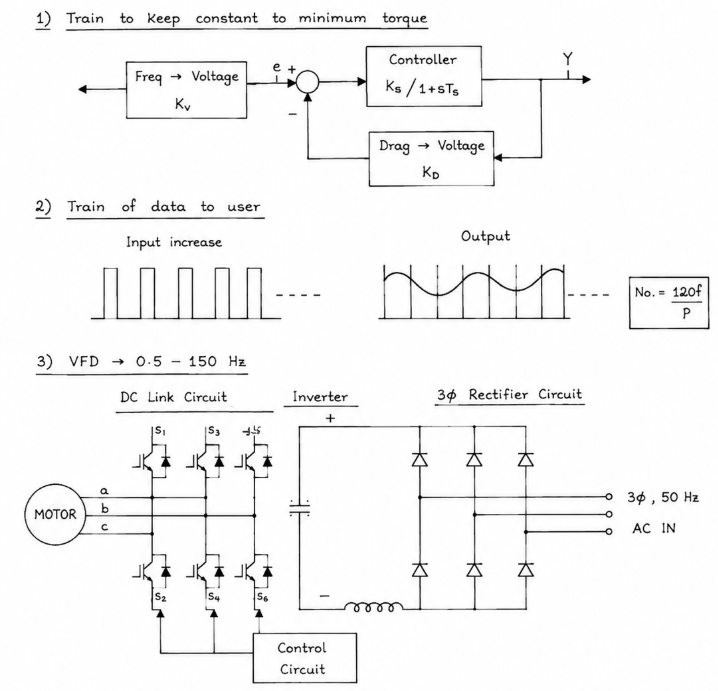
Variable Frequency Drive (VFD) is an electronic motor control system used to control the speed of an AC induction motor by varying the supply frequency and voltage. It is widely used in industries and marine engineering applications for smooth motor operation, energy saving, and accurate speed control.
Principle of VFD
The speed of an induction motor depends upon the supply frequency.
N_S= 120F/PNs = Synchronous Speed
f = Supply Frequency
P = Number of Poles
When frequency increases, motor speed increases.
When frequency decreases, motor speed decreases.
Main Parts of VFD
1. Rectifier Circuit
The rectifier converts incoming AC supply into DC supply using diodes or thyristors.
2. DC Link Circuit
The DC link circuit smoothens and filters the DC voltage using capacitors and inductors.
3. Inverter Circuit
The inverter converts DC supply back into variable frequency AC supply for controlling motor speed.
4. Control Circuit
The control circuit controls frequency, voltage, acceleration, deceleration, and motor protection functions.
Working of VFD
The incoming AC supply is first converted into DC by the rectifier section.
The DC link filters and stores the DC power.
The inverter section converts DC back into AC with variable frequency and voltage.
This variable supply is fed to the induction motor to control speed smoothly.
Functions of VFD
Speed Control Provides smooth and accurate speed control of induction motors.
Torque Control Maintains proper torque by controlling voltage and frequency simultaneously.
Soft Starting Reduces high starting current and mechanical stress during motor starting.
Energy Saving Motor runs only at required speed which reduces power consumption.
Advantages of VFD
1. Reduced Starting Current
Prevents excessive inrush current during motor starting.
2. Smooth Operation
Provides smooth acceleration and deceleration.
3. Improved Motor Life
Reduces wear and tear on motor and machinery.
4. Better Process Control
Improves operational efficiency and system reliability.
5. Reduced Maintenance
Less mechanical stress results in lower maintenance requirement.