


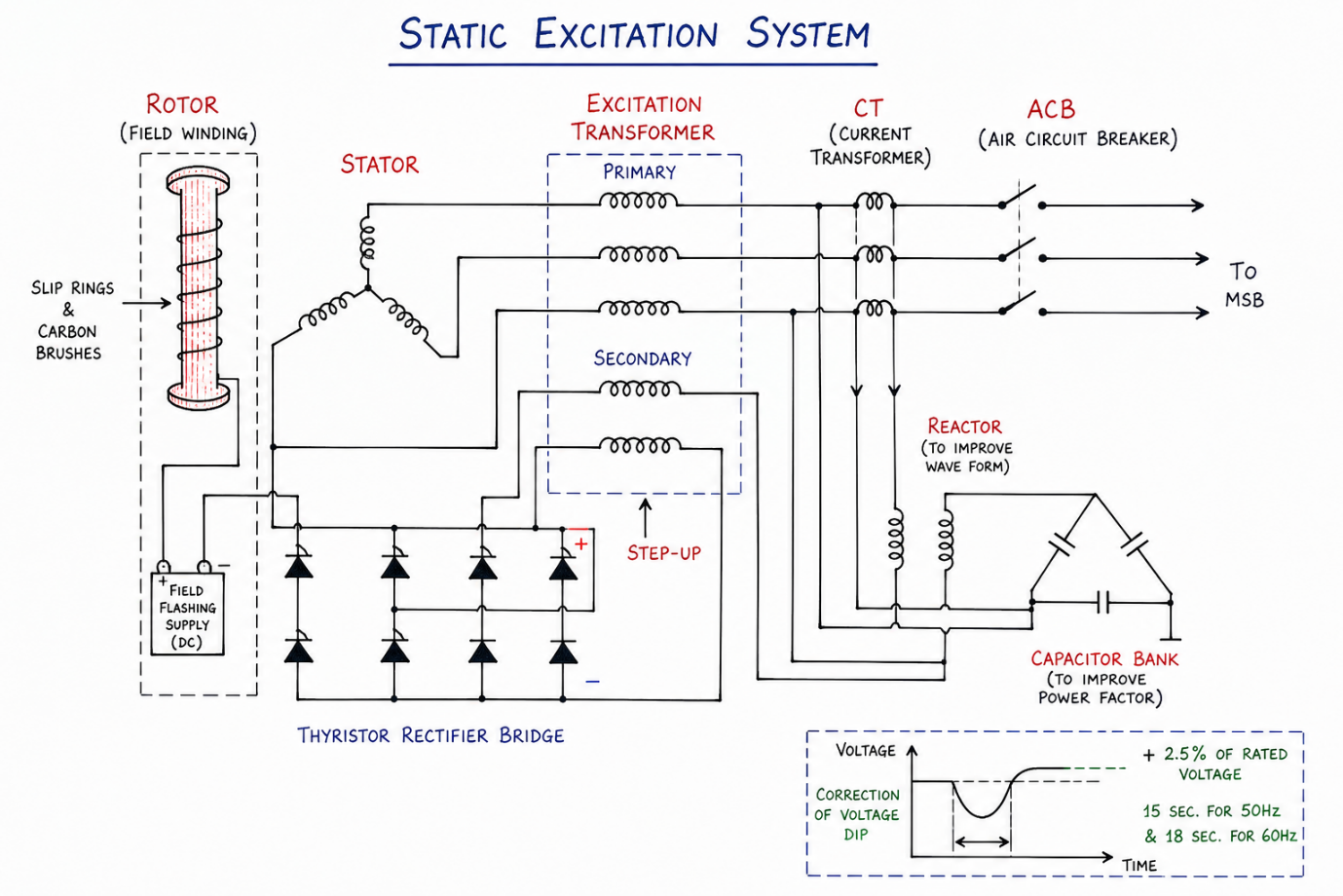
A Static Excitation System is a type of excitation system where the generator field (rotor winding) is supplied with DC power derived from the generator’s own output or an external AC source. Unlike older systems, it does not use rotating exciters. Instead, it uses power electronic devices such as thyristors to convert AC into controlled DC.
INTRODUCTION
In modern power generation systems, especially on ships and in power plants, maintaining a stable generator voltage is extremely important. Voltage fluctuations can damage equipment, affect system stability, and lead to unsafe operating conditions. To overcome these challenges, a Static Excitation System is widely used. It is a fast, reliable, and highly controllable method of supplying excitation current to the generator rotor.
Basic Working Principle
The basic working principle of a Static Excitation System is based on converting AC power from the generator terminals into controlled DC using a thyristor rectifier, which is then supplied to the rotor field winding through slip rings to produce the required magnetic field for voltage generation.
An Automatic Voltage Regulator (AVR) continuously senses the generator terminal voltage and compares it with a reference value, and accordingly
adjusts the firing angle of the thyristors to control the field current, ensuring that the generator output voltage remains constant even under varying load conditions with a fast and stable response.
Main Components of Static Excitation System
The main components of a Static Excitation System include the generator (stator and rotor), where the stator produces AC output and the rotor requires DC excitation; an excitation transformer, which adjusts the voltage level and provides isolation; a thyristor rectifier bridge, which converts AC into controlled DC; and an Automatic Voltage Regulator (AVR), which senses the generator voltage and controls the excitation by adjusting the firing angle of the thyristors.
In addition, the system consists of slip rings and carbon brushes for transferring DC supply to the rotating rotor, a field flashing system to provide initial excitation during startup, current transformers (CTs) for measurement and protection, an air circuit breaker (ACB) for connecting the generator to the main switchboard, and auxiliary components such as reactors and capacitor banks to reduce harmonics, improve power factor, and ensure overall stable and efficient operation of the system.
Comparison with Brushless Excitation
| Feature | Static Excitation | Brushless Excitation |
| Maintenance | Low | Moderate |
| Response | Very fast | Slower |
| Complexity | High | Medium |
| Reliability | High | High |
| Slip rings | Required | Not required |