


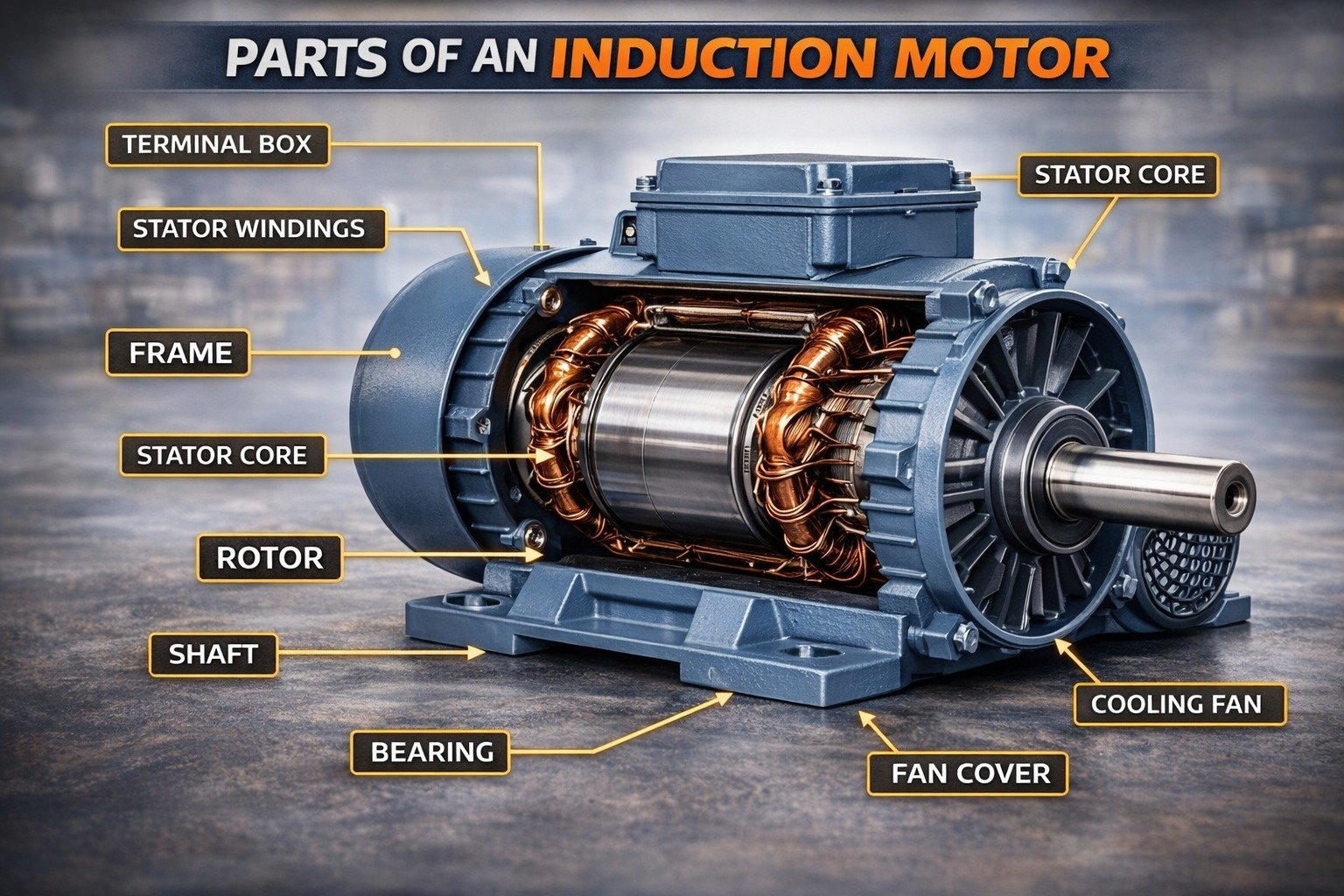
INTRODUCTION- The speed of an induction motor depends upon the synchronous speed and slip. The synchronous speed is given by:
NS = 120f / p
METHODS OF SPEED CONTROL
BY CHANGING FREQUENCY (VFD METHOD)–Speed is directly proportional to frequency. By varying supply frequency using a Variable Frequency Drive (VFD), motor speed can be smoothly controlled. Voltage is also varied along with frequency to maintain constant flux (V/f control).
ADVANTAGES-Smooth and stepless control, High efficiency, widely used in ships (pumps, fans, compressors)
DISADVANTAGES-Costly equipment, Harmonics may be introduced


By Changing Number of Poles-From formula: speed is inversely proportional to number of poles. By changing stator winding connections (pole changing method), different speeds are obtained.
Case 1: 8 Poles–Supply (Open connection shown)
No. of poles in this case = 8
Nₛ = 120f / p = (120 × 60) / 8 = 900 RPM
Case 2: 4 Poles
No. of poles = 4
Nₛ = 120f / p = (120 × 60) / 4 = 1800 RPM
oil Marking / Sequence: (a) (c) (b) (d)
Supply connections shown with direction of current and pole formation (N & S)
BY ROTOR RESISTANCE CONTROL (SLIP RING MOTOR)-External resistance is added in rotor circuit.
This increases slip → reduces speed.
ADVANTAGES-High starting torque simple method
Disadvantages-Power loss in resistors Poor efficiency only applicable to wound rotor motors
BY VOLTAGE CONTROL (STATOR VOLTAGE CONTROL)–Reducing stator voltage reduces torque → motor runs at lower speed.
APPLICATIONS-Fans, blowers (where load torque ∝ speed²)
DISADVANTAGES- Poor efficiency, Limited speed control range
CASCADE CONTROL (SLIP POWER RECOVERY)–Used in large slip-ring motors.
Rotor power is recovered and fed back to supply.
ADVANTAGES-Energy efficient, Suitable for large motors
POLE CHANGE METHOD SPEED CONTROL APPLICATION- Sea water pump motors → Davit motors → Crane motors


ADVANTAGES
- It is a very smooth speed control system over a wide range (from zero to normal rated speed)
- It can control the speed in both the direction
- The motor can run with a uniform acceleration
DISADVANTAGES
- The system is very costly because two extra machines
- Overall efficiency of system is not sufficient especially at light load
- Large size and weight require more space
Maintenance is more