


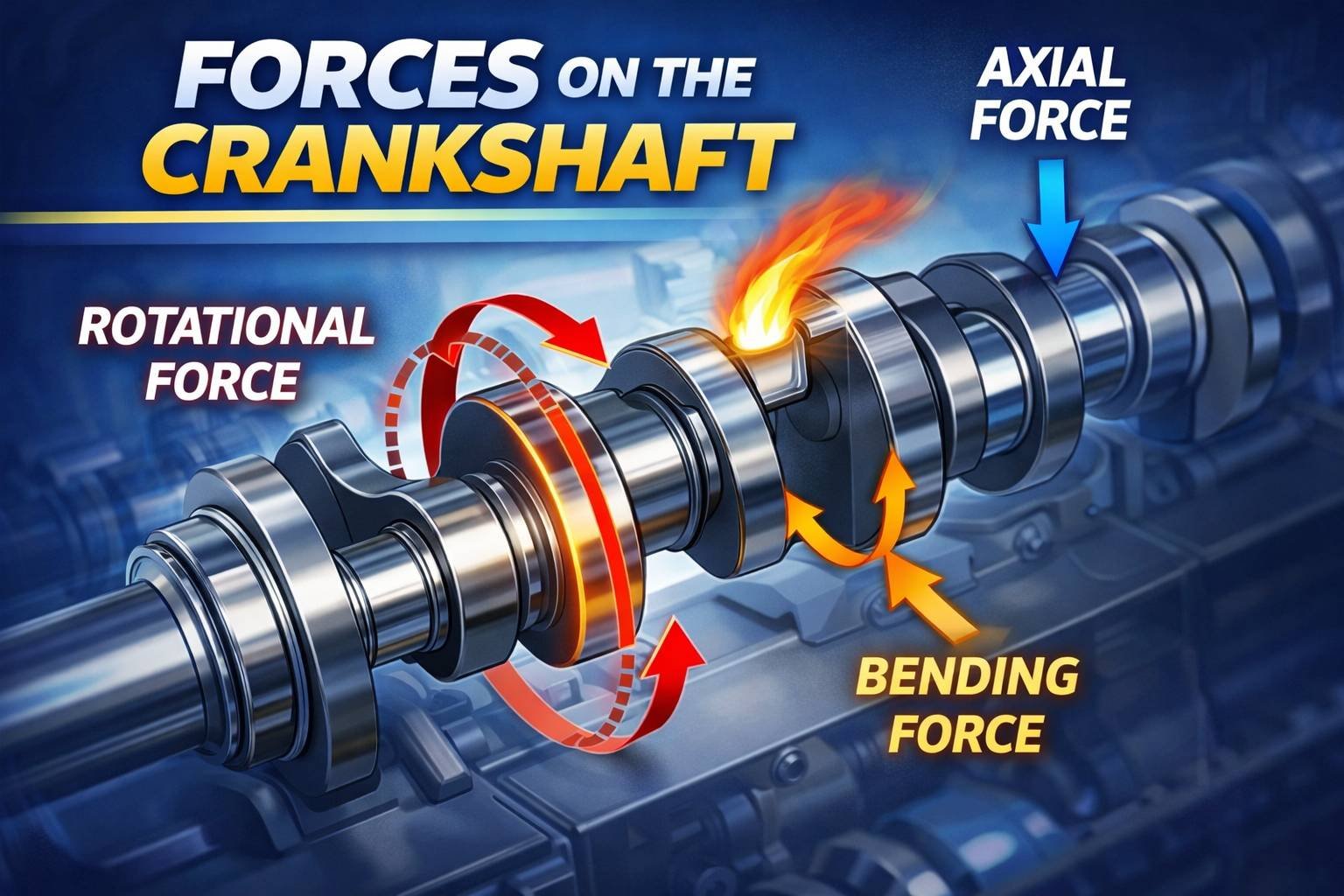
Forces on the Crankshaft– Due to its nature of operation, there are several types of forces which come to act upon the crankshaft of engines used in marine propulsion. You will get a better idea about these forces if you take a close look at the image shown below which shows the various twisting and bending forces.

- As can be seen from the figure, these forces are due to a variety of factors including but not limited to the weight of the pistons, combustion loads, the axial load from the propeller which is immersed in the sea, compressive loads of webs on journals and so forth.
- Most of these forces have alternating patterns which gives rise to fatigue and the materials used for construction need to have substantial Ultimate Tensile Strength. Apart from that the other properties required in the material of a crankshaft are wear resistance, tensile strength, and ductility.
- The material for construction also depends on the speed on the engine and slow speed marine diesel engines have crankshafts fabricated out of plain carbon steel with a percentage of carbon lying between 0.2 & 0.4%, while the alloy steels are used for engines having a relatively higher speed.
- Fully-built Crankshafts- are those in which all the various components are shrink-fitted after separate fabrication
- Semi-built Crankshafts- are those in which several parts such as crank-throw and pins are case out of a single piece.
- Welded Crankshafts- are those in which the crank-shaft is made by welding case web crank pins and half journal units.
- Flanged Coupling Crankshafts- are made out in two pieces joined together by flanged couplings
Why total reliance is placed on frictional grip in conventional built-up crankshaft on main engine?
- Frictional grip is the usual method of crankshaft construction for built-up crankshaft. This grip is subjected to the full torque of the engine output, and hence subjected to high torsional stresses. If there are any defects at this joint, then the resulting stress concentration would trigger a crack and possible shaft failure.
- To minimize the possibility of such defects, then only a frictional grip is permitted under Classification Rules for crankshaft construction, hence pins, keys, etc. are not allowed.
Why oil holes are given large fillets in crankpins and journals?
- Defect growth from a small surface defect into a crack that propagates through the shaft material require high levels of stress. Such levels of stress are possible when the stress is concentrated at section changes. The oil hole will inherently increase the local stress levels, and thus to minimize these increases, the oil hole will have a significant radius at the surface. The size of this radius will significantly influence the local stress levels, and should be closely monitored during crankshaft construction, and possible crankpin surface repairs by grinding.
- crankshafts for large 2 stroke crosshead engines are of the semi-built type. In this method of construction, the crankshaft “throws” consisting of two webs and the crankpin are made from a single forging of a 0.4% carbon steel. The webs are bored to take the separately forged and machined main journals which are fitted into the webs using the shrink fitting method described above. The shrink fit allowance is between 1/570 and 1/660 of the diameter.
The advantages of this method of construction are that by making the two webs and crankpin from a single forging the grain flow in the steel follows the web round into the crankpin and back down the other web.
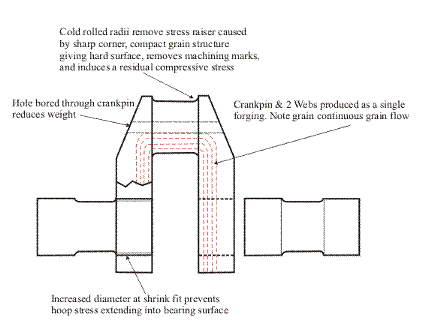
- Because the crankpin and webs are a single forging, the webs can be reduced in thickness and a hole is sometimes bored through the crankpin as shown, reducing the weight without compromising strength. Note however, there is a need for a good deal of material around the holes bored to take the main journals. This is because of the large tensile hoop stress present in the material after shrink fitting. This could lead to a crack in the web if the thickness here is not adequate or if the shrink fit is too tight or if there is a flaw in the material.